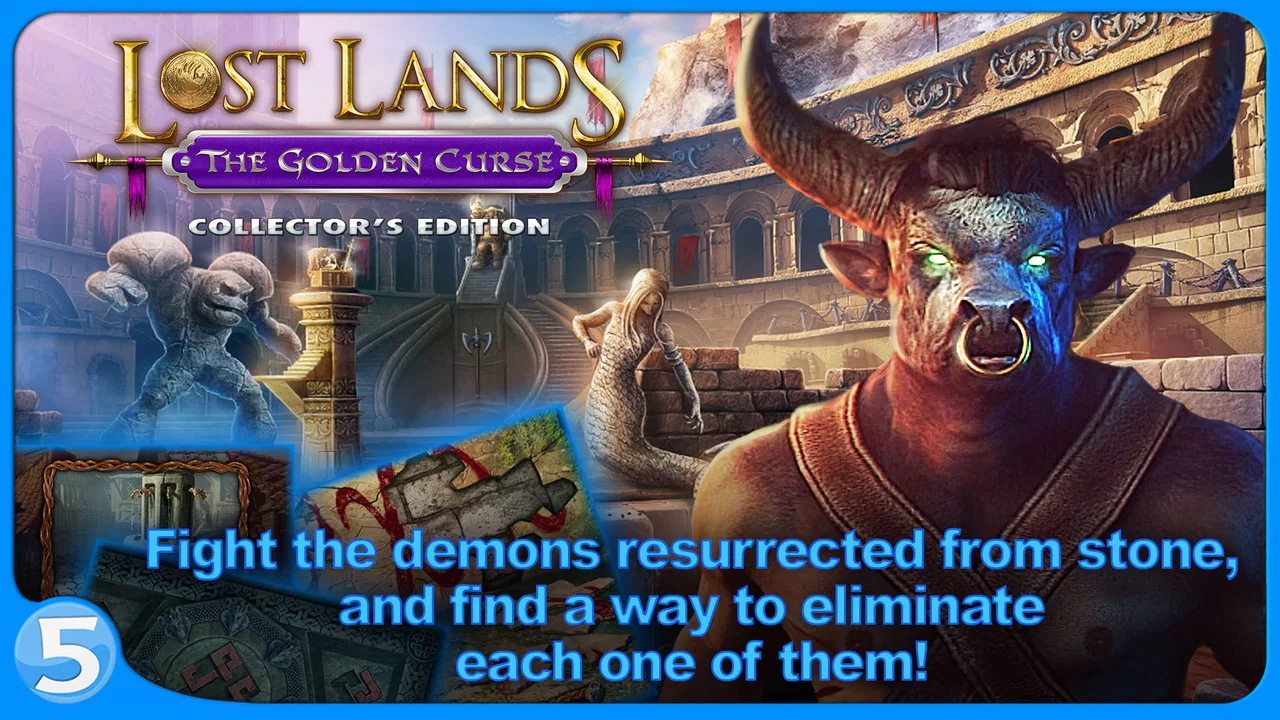
Lost Lands 3
- 4.7
- Rating
- 5.00M
- Installs
- Free
- Price

 Analysis by App-foxy
Some adventure games are built around constant action, while others ask you to slow down, observe, and connect small details. Lost Lands 3 belongs firmly to the second group. I found it most enjoyable when I treated it less like a quick mobile distraction and more like a compact mystery book with puzzles, exploration, and a fantasy setting to uncover. The central premise is clear: you are the last hope against an ancient curse, but the appeal comes from working out what that means one location, object, and conversation at a time.
Developed by FIVE-BN GAMES, this free adventure game is aimed at players who enjoy hidden-object scenes and point-and-click-style problem solving on a touchscreen. It is rated for Everyone, runs on devices using Android 7.1 or later, and has reached more than five million installs. Its average score sits at 4.7 from roughly 152 thousand ratings, which matches my impression that it has found a loyal audience among people who prefer thoughtful puzzles to reflex-based play.
How the everyday play loop works
The most useful way to approach Lost Lands 3 is to accept its rhythm. You move through a chain of distinct areas, inspect what is around you, collect objects, speak with characters, and return to earlier places when a new clue makes an old obstacle meaningful. The game does not feel designed for mindless tapping. It rewards remembering where you saw a locked mechanism, a strange symbol, or an item that seemed useless at the time.
You May Also Like

 Blood Strike: 2.5 Anniversary
Blood Strike’s Loadouts Turn Every Drop Into a Tactical Gamble
A close look at Blood Strike’s custom loadouts: how fast access to signature weapons reshapes its battle royale rhythm, rewards preparation, and narrows the gap between fights.

 Pandora - Music & Podcasts
Pandora’s Music Is Easy to Start, but Harder to Recover
Pandora’s strength is its low-effort path from a seed to a station. Its weak spot is how much confidence it asks you to place in connection, setup, and quiet recovery.

 8 Ball Pool
 Is Built on Rivalries, Rematches, and Routine
A close look at the rivalries, rematches, shared routines, and unanswered safety questions that turn a quick pool match into a persistent mobile community.

 Samsung Music
’s Quiet Strength Is Playing What You Already Own
Its reach comes less from spectacle than from dependable access to a personal library. That simplicity is both the app’s strongest retention engine and its ceiling.

 AccuWeather: Weather Radar
AccuWeather Review: A Quick, Clear Forecast for Everyday Decisions
For everyday plans, the best forecast is the one you can understand quickly. AccuWeather makes rain timing, radar, and local conditions easy to act on, with a few trade-offs.

 Hill Climb Racing
Why Hill Climb Racing Still Turns Crashes Into One More Run
A tiny car, a bumpy hill and one more upgrade: Hill Climb Racing keeps resurfacing because its simple chaos makes every near-miss feel personal.
More From Our News Desk



On a normal evening, I would play through one or two connected objectives rather than trying to finish a large portion in one sitting. I might begin by checking the current location for interactive objects, then open the inventory to see whether a recently collected item has an obvious purpose. After that, I would follow the strongest lead instead of touching every part of the screen repeatedly. This simple habit makes the adventure feel more coherent and reduces the frustration that comes from wandering without a plan.
The hidden-object sections fit naturally into that routine. They are not just interruptions between story scenes; they often provide the item needed to move forward. I recommend scanning the entire picture first, looking for shapes and colors that stand out, before tapping anything. When I rushed, I tended to overlook small objects placed near similarly colored scenery. A slower first pass was usually more effective than random tapping.
Inventory management is another important part of the baseline workflow. I found it helpful to inspect new items immediately, especially when their appearance suggested a tool, key, fragment, or component. Some objects are not useful in the place where they are found, so I avoided assuming that every pickup had an immediate purpose. Keeping a mental note of unusual locations saved time later, particularly when the game introduced a clue that referred back to an earlier area.
Exploration feels better when you build a mental map
Lost Lands 3 uses a structure that encourages backtracking, and that can be either satisfying or tiring depending on how you play. I started remembering locations by their visual identity rather than by trying to memorize every screen name. A damaged structure, a forest path, and a puzzle room each became a reference point in my head. When I acquired a new object, I could then ask which place looked designed for it instead of revisiting everything at random.
This is one of the game’s less obvious strengths: it makes attention useful. If you notice a symbol, a pattern, or an object that does not yet have a purpose, you are effectively creating your own future checklist. I sometimes wrote a few short notes outside the game when I paused for the day. That may sound excessive for a mobile title, but it is genuinely practical during longer sessions because the game expects you to remember relationships between areas rather than simply follow a glowing arrow.
Conversations also deserve more attention than a quick tap-through approach gives them. I read dialogue carefully because it often establishes the reason an object matters or points toward the next kind of interaction. The story is not merely decoration around the puzzles. It provides context for why I was exploring a place and made the unusual items feel connected to the world instead of randomly scattered collectibles.
Settings and play habits worth checking first
Before settling into a long session, I would check the available in-game options and make sure the presentation feels comfortable on the phone or tablet I am using. Adventure games depend heavily on seeing small details, so screen brightness, text readability, and touch accuracy matter more here than they would in a fast arcade game. I also prefer playing with enough uninterrupted time to think, because repeatedly leaving during a puzzle makes the clues harder to hold in mind.
The current Android version is 2.1.4.1597.251, and the minimum operating-system requirement is Android 7.1. That makes the game accessible to many older devices, although the experience still depends on the condition of the individual phone. A larger screen is more comfortable for hidden-object scenes, while a smaller display can make tiny visual details easier to miss. If you are choosing between a phone and a tablet already available to you, I would favor the larger screen for puzzle-heavy sessions.
I also recommend deciding in advance whether you want hints to be a safety net or a regular shortcut. Using them immediately can weaken the satisfaction of solving a scene yourself, but refusing them at all costs can turn a pleasant evening into a tedious search for one nearly invisible item. My preferred rule was to make a serious attempt first, then use assistance only after I had checked the whole scene and reviewed the relevant objective.
Because the game is free to download and includes in-app purchases ranging from $0.99 to $14.99 per item, it is worth thinking about your spending boundary before you begin. I would not treat purchases as part of the normal workflow. The better experience comes from exploring and solving at your own pace, while optional paid help is best viewed as a convenience for someone who is stuck or wants to reduce repetition.
Faster patterns for solving without losing the story
Experienced play is not about tapping faster. It is about reducing unproductive movement. My first useful pattern was to finish a visual scan of the current location before opening the inventory. That prevents me from switching back and forth between screens without a reason. Once I had checked the environment, I compared the available items with the visible obstacles and selected the most plausible match.
A second pattern was to group clues by type. I mentally separated direct-use objects, combination pieces, symbols, and information clues. If I found a fragment that looked incomplete, I did not waste time trying it on every lock. If I saw a sequence or emblem, I looked for a nearby mechanism that could display the same kind of information. This approach made the puzzles feel more logical and helped me avoid treating every item as a universal key.
When returning to an earlier area, I did not begin with a complete recheck of every object. I focused on places that had previously been blocked, incomplete, or visually suspicious. This is a small habit, but it makes a major difference in a game built around revisiting locations. I also tried to complete a chain of related actions before stopping, because ending immediately after finding a new clue made it harder to remember what had changed when I returned later.
For hidden-object scenes, I used a three-pass method. First, I looked for obvious objects. Second, I searched by the shape suggested by the list, especially for items that could blend into the background. Third, I checked corners, borders, and areas partly covered by scenery. I avoided tapping rapidly across the image because that approach feels quick but often creates more confusion than progress. The game rewards visual patience more than speed.
Another practical tip is to treat the objective text as a question rather than a command. If the task says you need to open, repair, find, or activate something, I ask what kind of evidence would prove that action is possible. That change in wording helped me notice when I was trying to use an item too early or in the wrong location. It also kept the story and puzzle logic connected instead of turning the game into a sequence of disconnected chores.
Where the design reaches its limits
The same backtracking that creates satisfying connections can become the game’s main source of friction. If you forget where an object was found or why a character mentioned a particular place, progress can slow down quickly. This is not a game I would recommend to someone who wants a clear objective marker and a short, predictable session. It asks for memory, observation, and a willingness to revisit a location without being certain that it contains the answer.
The hidden-object format also has an unavoidable trade-off. When an item is cleverly integrated into the scenery, finding it feels rewarding. When it blends too well with similar colors or textures, the challenge can feel more like a test of eyesight than reasoning. I found that playing on a bright, larger screen helped, but it did not remove the occasional moment when I was searching for a tiny detail rather than solving a meaningful puzzle.
The game is less suitable for players who dislike reading. The atmosphere depends on the setting and the conversations, and skipping dialogue makes the objectives feel less motivated. Likewise, anyone looking for combat, character builds, or deep action mechanics should choose a different adventure game. Lost Lands 3 is about investigation and puzzle progression, not controlling a powerful character through repeated battles.
Its free entry is appealing, but the presence of optional purchases can still affect how some players feel about getting stuck. I preferred to keep purchases separate from my normal decision-making and use the game’s own clues first. If you know that a difficult puzzle will tempt you into paying simply to avoid thinking, this may not be the best choice for you. A traditional paid puzzle adventure may feel more comfortable, even if it offers less flexibility at the start.
There is also a difference between playing on a quiet afternoon and playing in short fragments while commuting or waiting in line. In brief sessions, I sometimes forgot the exact connection between an item and an earlier scene. The game works better when you can give it enough attention to remember the current thread. For a quick five-minute pastime, a simple match game or endless runner is more convenient; for an evening of focused exploration, this is the stronger option.
Who will get the most from this adventure
I would recommend Lost Lands 3 to players who enjoy combining visual searches with environmental puzzles and story-led exploration. It is especially appealing if you like games that let you solve problems through observation rather than demanding fast reactions. The Everyone rating also makes it a broadly approachable choice for families, although younger players may still need help with the more abstract connections and the amount of reading involved.
It is a good fit for someone who wants a free starting point before committing to a larger adventure. You can explore its style, puzzle structure, and storytelling without paying upfront, then decide whether optional purchases are worthwhile for your personal play style. I would also suggest it to fans of classic point-and-click adventures who want something adapted to touch controls, provided they are comfortable with hidden-object scenes.
I would skip it if your priority is competitive play, constant action, or a tightly guided route from one objective to the next. I would also look elsewhere if you find backtracking inherently annoying. The game’s best moments come from recognizing a connection you noticed earlier, so the very quality that makes it satisfying can feel slow when you want immediate progress.
My verdict after settling into its rhythm
What stayed with me was not a single flashy mechanic but the steady feeling of assembling a larger mystery from modest discoveries. The environmental details, inventory decisions, conversations, and hidden-object scenes work best when I give them room to connect. I enjoyed it most when I stopped asking, “What can I tap?” and started asking, “What has changed, and what earlier clue now matters?”
The best way to play is patiently, with a simple memory habit and a deliberate approach to hints. That advice sounds basic, but it directly addresses the game’s real demands. Scan before tapping, inspect new objects, remember blocked locations, and return only when you have a reason. Those habits make the adventure smoother without taking away the satisfaction of solving it.
With a 4.7 average and more than five million installs, the game has clearly connected with a substantial audience, and I can understand why. It offers a substantial-feeling fantasy investigation without requiring an upfront purchase, while the developer, FIVE-BN GAMES, keeps the focus on exploration and puzzle solving. The free model and Everyone rating make it easy to try, though the optional purchases and occasional visual ambiguity are worth keeping in mind.
In the end, Lost Lands 3 is best for a player who enjoys slowing down and noticing things. I would choose it over a generic action adventure when I want a quiet, puzzle-centered session with a sense of place. I would not choose it for a quick burst of entertainment or a combat-heavy challenge. If you are willing to keep track of clues, tolerate some backtracking, and use help thoughtfully, it becomes a rewarding companion for a focused evening rather than just another game to tap through.
FAQs for Lost Lands 3
01What is Lost Lands 3 about?
Lost Lands 3, also known as Lost Lands: The Golden Curse, is a fantasy hidden-object adventure game from FIVE-BN Games. You follow Susan as she returns to the mysterious Lost Lands to investigate a new threat involving ancient creatures, magical locations, and a powerful curse. The game combines exploration, puzzle solving, item collection, and story-driven conversations in a classic point-and-click style.
02How does the gameplay work in Lost Lands 3?
The game is built around exploring detailed locations, finding useful objects, completing hidden-object scenes, and solving environmental puzzles. You will often need to combine items, revisit earlier areas, and pay attention to clues in the surroundings. Progress depends on observation and logical thinking rather than fast reactions, making it a relaxed adventure for players who enjoy mystery games and traditional quest mechanics.
03Is Lost Lands 3 suitable for beginners?
Yes, Lost Lands 3 is generally accessible to beginners, especially if you enjoy hidden-object or casual adventure games. The objectives are presented through a clear narrative, and the game includes helpful features such as a hint system and a map in many versions. Some puzzles can still be challenging, but patient players can usually solve them by examining objects and reviewing the story clues.
04Can Lost Lands 3 be played offline?
Lost Lands 3 is primarily a single-player adventure and does not require constant online interaction for its main gameplay. After installation, most exploration, puzzles, and story content can normally be enjoyed offline. However, download requirements, advertising, optional purchases, cloud features, or platform-specific services may vary between Android and iOS versions, so checking the store listing is recommended.
05Is Lost Lands 3 free to download and does it include in-app purchases?
The availability and pricing of Lost Lands 3 can differ depending on the device, region, and store version. Some editions allow players to download the game for free while offering optional purchases, advertisements, or access to additional content. Before installing, review the current Google Play or App Store listing to confirm the price, included chapters, payment options, and whether the complete adventure is unlocked.
Pros
- Atmospheric locations make exploration feel immersive.
- Puzzles offer satisfying variety without being overly repetitive.
- Hints are available when you get stuck.
- The story connects well with earlier Lost Lands entries.
- Offline play makes it convenient for travel.
Cons
- Some puzzle solutions feel obscure without using hints.
- The inventory system can be awkward to navigate.
- A few scenes involve lengthy backtracking.
- The opening may feel slow for impatient players.
- The full adventure requires an additional purchase.

Lost Lands 3
Gallery